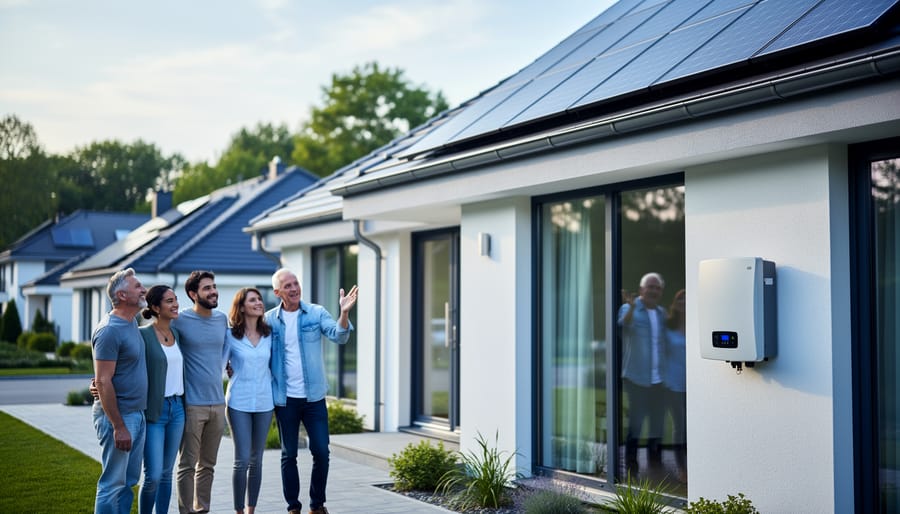
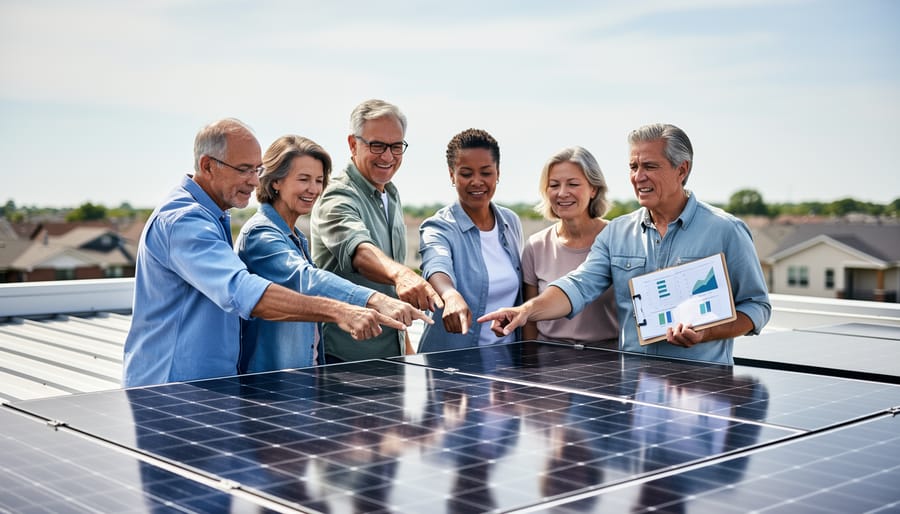
Solar adoption programs are transforming how neighborhoods, municipalities, and organizations embrace clean energy. Instead of homeowners navigating solar installation alone, these initiatives bring people together to negotiate better pricing, share knowledge, and accelerate the transition to renewable power across entire communities.
The concept works through collective purchasing power. When dozens or hundreds of households commit to going solar simultaneously, they unlock significant discounts that individual buyers rarely access. Programs in Massachusetts reduced installation costs by 20-30% in 2025, while similar initiatives in Colorado saw participation rates triple compared to individual adoption efforts. This collaborative model removes major barriers: high upfront costs, confusing contractor selection, and the isolation many feel when making such a significant home investment.
What makes these programs particularly effective is their built-in support system. Community workshops demystify solar technology, vetted installers compete for bulk contracts, and neighbors share real experiences. The result? Faster decision-making and higher satisfaction rates.
Whether you’re a community leader exploring how to launch a program in your area, a homeowner wondering if joining makes financial sense, or an advocate seeking proven models to replicate, understanding how successful solar adoption programs operate is your first step. From Portland’s group-buy initiatives serving 500+ homes to rural cooperatives pooling resources for shared solar farms, these programs prove that collective action drives meaningful change.
The shift from individual consideration to community movement is reshaping America’s solar landscape in 2026, making clean energy accessible to families who thought it was out of reach.
What Makes a Solar Adoption Program Successful
A solar adoption program is an organized initiative that helps residents, businesses, or entire communities transition to solar energy through coordinated support, shared resources, and collective action. These programs function as bridges between interested adopters and the solar marketplace, removing barriers that typically prevent individuals from going solar on their own.
The distinction between programs that thrive and those that fizzle out comes down to several critical elements working in concert.
Successful programs place community members at the center of decision-making rather than treating them as passive recipients of clean energy messaging. When neighbors recruit neighbors and local leaders champion the cause, participation rates climb dramatically. Programs that rely solely on top-down directives from utilities or government agencies struggle to build the trust and momentum needed for meaningful adoption.
Affordability mechanisms determine whether a program reaches beyond early adopters who already have capital to invest. The most effective programs deploy multiple strategies to address upfront costs: group purchasing discounts that reduce installation prices by 15-30%, streamlined access to federal and state incentives, vetted financing options with transparent terms, and income-qualified pathways that ensure lower-income households can participate. Programs that fail to tackle the cost barrier see minimal uptake regardless of how enthusiastic the community might be about clean energy.
Successful solar adoption programs share these core elements:
- Strong community engagement with local champions driving participation
- Multiple affordability pathways including group discounts and accessible financing
- Comprehensive education addressing technical questions and dispelling myths
- Pre-vetted solar installers with competitive, transparent pricing
- Scalable models that can expand beyond initial pilot neighborhoods
- Clear metrics tracking installations, savings, and carbon reductions
Education components separate programs that generate dozens of installations from those that generate hundreds. Effective programs don’t just advertise solar benefits, they create multiple touchpoints where community members can ask questions, see real installations in their neighborhood, and hear from peers who’ve already made the switch. Workshops, online resources, and one-on-one consultations help people move from curiosity to commitment.
Scalability ensures a program can grow beyond its founding group. The best programs document their processes, create replicable frameworks, and share lessons learned so other communities can adapt their model. Programs designed around unique circumstances that can’t be transferred remain valuable but limited in their broader impact on the renewable energy transition.
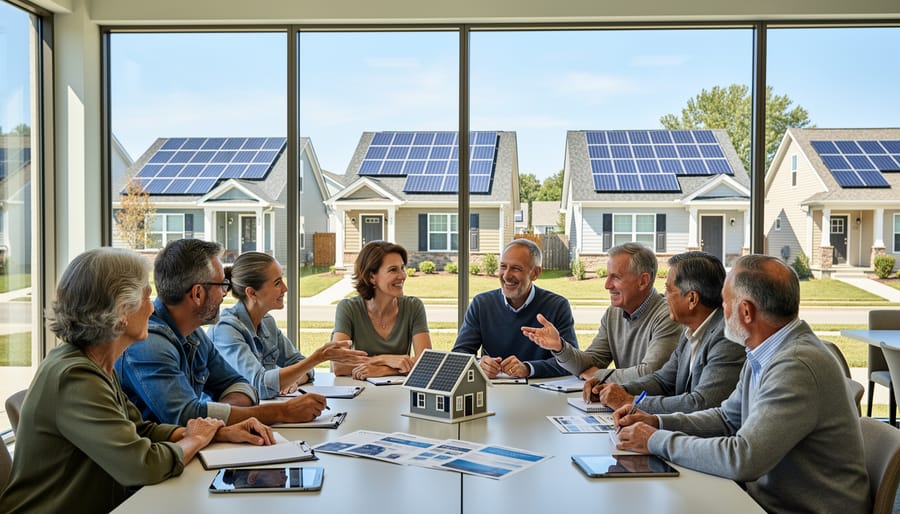
Community-Led Solar Adoption Models That Deliver Results
Solarize Campaigns: Neighborhood Power in Action
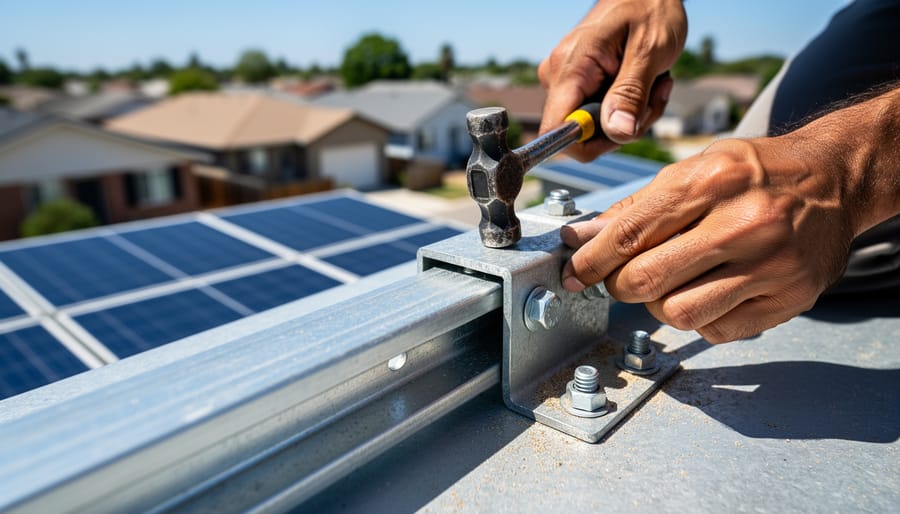
Solarize campaigns turn your neighbors into a solar buying cooperative. Instead of each household negotiating individually with installers, communities band together, typically 50 to 300 households, to secure volume discounts of 15-30% off standard installation costs. A local organizing team recruits participants through block parties, community meetings, and door-knocking, creating social proof that makes going solar feel less like a risky leap and more like joining your neighbors in something smart.
The mechanics are straightforward. Communities partner with a pre-vetted solar installer who offers discounted rates in exchange for guaranteed volume. As more households sign contracts, the price drops in tiers, creating a built-in incentive for neighbors to recruit neighbors. Most campaigns run for 3-4 months, starting with educational workshops that demystify solar technology, financing options, and the timeline from contract to flip-the-switch.
After our Solarize campaign installed 87 systems in four months, my electric bill dropped to nearly zero and suddenly solar panels popped up on every third house, it became the new normal instead of the exception.
Boulder County’s 2025 Solarize campaign demonstrated this model’s power. The program enrolled 124 households in three months, installing 1.8 megawatts of capacity at an average cost 22% below market rates. In Portland’s Powellhurst-Gilbert neighborhood, a 2026 Solarize effort specifically targeted low-income households, pairing group discounts with state incentives to make solar cash-flow positive from day one for families earning under 80% of median income.
The community organizing component matters as much as the discount. Peer influence, seeing your neighbor’s panels go up, hearing their savings story at the dog park, breaks down the psychological barriers that keep solar adoption rates low even when economics make sense.
Community Solar Programs: Access for Everyone
Community solar offers a breakthrough for anyone locked out of rooftop solar. These programs let renters, condo owners, and homeowners with shaded or unsuitable roofs subscribe to a portion of a shared solar array built on a nearby site, a farm, warehouse roof, or dedicated solar field. You receive credits on your utility bill for the energy your share produces, typically saving 5 to 15 percent on electricity costs without any equipment on your property.
The model works especially well for lower-income households. Many community solar projects reserve slots for income-qualified subscribers or offer deeper discounts, sometimes 20 to 30 percent savings, funded by federal tax credits that the project developer claims. No credit check or upfront payment is required for most subscriptions, removing the biggest barrier that keeps rooftop solar out of reach for families who would benefit most from lower energy bills.
Community solar arrays also scale faster than individual installations. A single 2-megawatt project can serve 200 to 400 households, and the role of local governments in streamlining permits and identifying suitable land has accelerated deployment across the country. In 2026, community solar capacity reached 7.5 gigawatts nationwide, enough to power more than 1.4 million homes.
Subscribers can cancel or move without penalty in most programs, maintaining flexibility that fixed rooftop systems cannot match. This portability makes community solar ideal for transient populations and anyone hesitant to commit long-term. When adoption programs include community solar alongside traditional rooftop options, participation rates rise by 40 to 60 percent because the model genuinely works for everyone.
Municipal Solar Adoption Initiatives
Cities and counties are taking the lead with solar adoption programs that remove red tape and provide direct support to residents and businesses ready to make the switch. These municipal initiatives tackle the practical barriers that often stall solar projects: confusing permitting processes, upfront costs, and lack of reliable information.
Austin Energy’s Solar Adoption Program offers rebates up to $2,500 for residential installations and expedited permit approval within 48 hours for standard rooftop systems. The city also trains local installers on streamlined documentation requirements, which has cut average project timelines from 12 weeks to 6 weeks. Since launching this comprehensive approach in 2025, Austin has seen residential solar installations increase by 340%.
San Diego County combines property tax exemptions for solar equipment with a one-stop permitting portal that connects homeowners directly with pre-qualified contractors. Their “Solar Ready” program provides free site assessments and customized financing options based on household income, making solar accessible across economic brackets.
These programs work because they address the entire adoption journey. Minneapolis offers group training sessions where residents learn about technology, financing, and incentives in their neighborhood library, then connects them with vetted installers who understand the city’s requirements. The result: informed homeowners who complete projects faster and with greater confidence.
The most effective municipal solar adoption programs share a common trait, they make going solar easier than not going solar by eliminating friction at every step.
How to Launch a Solar Adoption Program in Your Community
Starting a solar adoption program in your community doesn’t require deep technical expertise, it requires commitment, organization, and a clear roadmap. Here’s how to move from idea to action.
**Assess Community Interest and Identify Champions**
Begin by gauging interest among neighbors, civic groups, and local organizations. Host an informal gathering or create a simple online survey asking who’d consider solar and what barriers they face. You need to identify 3-5 committed individuals willing to invest time beyond casual interest. These champions form your core team. Look for people with complementary skills: someone who understands finance, a strong communicator, a person with municipal connections, and an organizer who can mobilize volunteers.
**Research Existing Solar Adoption Program Models**
Before reinventing the wheel, study what works. Review Solarize programs in other communities, community solar projects, or municipal initiatives that have published results. Contact coordinators from successful programs, most are eager to share lessons learned. Determine which model fits your community’s characteristics: dense urban areas might favor community solar subscriptions, while suburban neighborhoods with many homeowners could benefit from a Solarize campaign, and rural communities might need a hybrid approach.
**Engage Local Government Early**
Schedule meetings with city council members, sustainability officers, and planning departments within your first month. Present the concept and ask specific questions: What permits are required? Can the city provide meeting space or communications support? Are there existing clean energy goals this program would advance? Some municipalities will offer staff time, marketing assistance, or seed funding. Others may be neutral or cautious, document their concerns and address them systematically.
**Secure Initial Funding and Resources**
Most solar adoption programs launch with modest budgets: $2,000-$10,000 covers website development, educational materials, community meetings, and administrative costs. Funding sources include local government grants, environmental nonprofit partnerships, crowdfunding from interested residents, and sometimes matching funds from solar installers who see value in aggregated customers. Create a simple budget showing how funds will be spent and what outcomes you expect, X households educated, Y site assessments completed, Z installations targeted.
**Select and Vet Solar Installers**
Issue a Request for Proposals to local and regional solar companies, asking them to bid on becoming your program’s preferred installer. Evaluate companies based on pricing, experience with group purchasing programs, financing options they offer, customer service record, and local hiring practices. For a Solarize campaign, negotiate volume-based pricing tiers that reward higher participation. Have your team’s finance-savvy member review proposals carefully, some installers offer unsustainably low bids hoping to upsell later.
**Create an Outreach and Education Strategy**
Education drives participation. Plan a kickoff event where the selected installer presents solar basics, financing, and the program’s specific benefits. Schedule monthly workshops covering different topics: understanding your electric bill, federal and state incentives, the installation process, what to expect in year one. Use multiple channels, neighborhood newsletters, social media, yard signs, library bulletin boards, and word of mouth through faith communities and civic clubs. Personal testimonials from early adopters are your most powerful marketing tool.
**Establish Clear Program Guidelines and Timeline**
Define participation requirements, deadlines, and what the program provides versus what participants handle themselves. Typically, the program offers group pricing, vetted installers, educational resources, and peer support. Participants commit to getting a free site assessment by a deadline, then decide whether to proceed. Set a campaign duration, most run 6-12 months, with clear milestones: enrollment opens, assessment deadline, installation period begins, campaign concludes.
**Launch and Support Participants Through Installation**
Once you go live, maintain momentum through regular communication. Send weekly updates on enrollment numbers, share new testimonials, and remind people of upcoming deadlines. Create a buddy system pairing interested residents with those who’ve already installed systems. Track your metrics: site assessments completed, contracts signed, systems installed, total capacity added. These numbers become your proof of concept for future programs or expansion.
Real Communities, Real Impact: Solar Adoption Success Stories
Communities across the country have transformed their energy landscapes through well-designed solar adoption programs. These aren’t theoretical success stories, they’re real neighborhoods where collective action delivered measurable results in 2025 and 2026.
In Portland, Oregon, the Southeast Neighborhoods Solarize campaign brought together twelve neighborhoods in spring 2025. By negotiating bulk pricing with vetted installers and organizing monthly community meetups, the program made residential solar accessible to households that previously found it out of reach. Local volunteers knocked on doors, answered questions at farmers markets, and shared their own installation experiences. The results speak clearly: 287 homes added solar panels between March and October 2025, generating an estimated 1,600 megawatt-hours annually. Participants report average savings of $1,200 per year on electricity bills, while the collective installations offset approximately 1,100 metric tons of carbon dioxide emissions annually, equivalent to taking 240 cars off the road.
Charlotte, North Carolina’s community solar program took a different approach, focusing on renters and lower-income residents who couldn’t install rooftop panels. Launched in January 2026, the initiative partnered with a local utility to build three solar gardens totaling 5 megawatts across the city. Residents subscribe to portions of these arrays and receive credits on their electric bills. Within five months, 820 households enrolled, with 60% qualifying as low-to-moderate income. Subscribers save between 10-15% on their monthly electricity costs without any upfront investment, while the arrays generate enough clean energy to power roughly 650 homes.
| Community | Program Type | Installations/Subscribers | Annual Impact |
|---|---|---|---|
| Portland, OR | Solarize Campaign | 287 installations | 1,100 tons CO2 offset |
| Charlotte, NC | Community Solar | 820 subscribers | 5 MW clean capacity |
| Boulder, CO | Municipal Program | 412 installations | $580,000 annual savings |
| Madison, WI | Solar Co-op | 156 installations | 900 tons CO2 offset |
Boulder, Colorado streamlined its municipal permitting process and offered rebates that covered 20% of installation costs for residents. The city’s SolarBoost program, relaunched in summer 2025, also provided free energy assessments and connected homeowners with certified installers. Four hundred twelve homes went solar in twelve months, collectively saving residents an estimated $580,000 annually.
Madison, Wisconsin’s Solar for Good cooperative demonstrated what dedicated volunteers can accomplish. This grassroots program organized workshops, shared financing information, and created a trusted network of installers. Starting with just 23 founding members in late 2024, the co-op grew to 156 completed installations by mid-2026, proving that neighbor-to-neighbor education drives adoption as effectively as financial incentives.
These communities didn’t wait for perfect conditions. They identified local barriers, mobilized residents, and built programs that matched their specific circumstances. The installations, savings, and emissions reductions prove that solar adoption programs deliver when communities commit to making them work.
Overcoming Common Barriers to Program Success
Even the most well-designed solar adoption programs hit predictable roadblocks. The difference between programs that stall and those that thrive often comes down to how organizers address these challenges head-on.
Financing concerns top the list. Many residents assume they can’t afford solar, even when programs offer group discounts. The solution? Lead with total cost of ownership, not just upfront price. Programs in Boulder, Colorado succeeded by presenting 20-year savings projections during initial meetings, showing how monthly loan payments would be lower than current electric bills. Offer multiple financing options at the outset, cash purchase, loans, leases, and power purchase agreements, so every household finds a path that fits their budget.
Resistance to change runs deeper than economics. Homeowners worry about roof damage, maintenance headaches, or diminished property values. Counter these fears with data from your own community. Portland’s 2025 Solarize campaign invited early adopters to host yard signs with their actual savings numbers and QR codes linking to their installation experience. This neighbor-to-neighbor validation proved far more persuasive than any brochure. Consider organizing home tours where skeptics can see functioning systems and ask candid questions of people they know.
Misinformation spreads quickly, particularly claims that solar doesn’t work in cloudy climates or that panels create toxic waste. Combat this with hyperlocal facts. Calculate real production data from installations in your area, not national averages. Partner with reputable installers who can address recycling programs and warranty specifics. Minneapolis programs defeated the “solar doesn’t work here” myth by publishing monthly generation reports from actual neighborhood installations throughout winter.
Regulatory hurdles vary wildly by jurisdiction. Lengthy permitting processes and outdated electrical codes have killed momentum in otherwise enthusiastic communities. Work with your program organizer to present data to local officials showing how streamlined permitting in comparable cities has accelerated clean energy adoption without compromising safety. Some programs have successfully lobbied for same-day inspections for standardized residential systems.
When barriers arise, document your solutions. Every challenge you solve makes the path smoother for the next community launching their own solar adoption program.
Getting Involved: How You Can Support Solar Adoption
Finding your place in a solar adoption program depends on your situation, but every community member can contribute to accelerating clean energy transitions where they live. Here are concrete ways to get involved based on your role:
**Homeowners** can take the most direct action by joining an existing Solarize campaign or community solar program in their area. Contact your local sustainability office or environmental nonprofits to find active programs, then attend information sessions and encourage neighbors to participate. If no program exists, gather interested neighbors and reach out to organizations like Solar United Neighbors or local clean energy groups about launching a campaign. Even if your roof isn’t suitable for solar, you can host educational meetings or serve as a neighborhood ambassador who shares information and answers questions.
**Renters** shouldn’t assume solar is out of reach. Subscribe to community solar gardens if your utility offers them, these subscriptions typically save money on electricity bills without requiring rooftop installation or property ownership. Advocate with your landlord about solar installation by sharing information on how solar panels increase property values and can attract sustainability-minded tenants. Join renter-focused advocacy groups pushing for policies that expand community solar access and tenant protections for solar subscriptions.
**Business owners** can amplify solar adoption by installing systems on commercial properties and publicizing the decision to inspire others. Partner with local solar adoption programs as sponsors or meeting hosts, offering your business space for community gatherings and providing credibility through your participation. Create employee solar education programs and consider offering workplace solar benefits like group purchasing discounts or payroll-deduction options for community solar subscriptions.
**Community leaders** drive program success through several channels:
- Convene stakeholders including utilities, installers, local government, and community organizations to explore program structures
- Secure seed funding through grants, municipal budgets, or philanthropic sources to cover startup costs
- Build partnerships with experienced organizations that have successfully launched programs elsewhere
- Champion supportive policies such as streamlined permitting, updated zoning codes, and incentive programs
- Organize community education events, workshops, and peer-to-peer learning opportunities
- Recruit diverse volunteers who represent different neighborhoods and demographics to ensure inclusive outreach
Regardless of your role, start by researching what solar adoption programs already exist in your region and connecting with the people running them. These programs only succeed when community members show up, participate, and bring their networks along. Your involvement, whether as an early adopter, a vocal advocate, a financial supporter, or an organizer, creates momentum that makes solar adoption easier for everyone who follows.
The success stories you’ve read aren’t anomalies, they’re proof that solar adoption programs thrive when neighbors work together toward a common purpose. A single household going solar makes a difference, but a coordinated community effort creates momentum that transforms entire neighborhoods and inspires others to follow.
You don’t need to be an energy expert or policy maker to bring solar to your community. Start by talking to your neighbors about their interest in clean energy. Reach out to local environmental groups already active in your area. Contact your city council representatives about supporting solar initiatives. These small actions create the foundation for larger change.
The most effective programs begin with a handful of committed individuals who refuse to wait for someone else to take the lead. Whether you organize a Solarize campaign, advocate for community solar access, or simply educate your neighbors about available incentives, you’re contributing to a movement that extends far beyond your property line.
Your community’s solar future depends on people willing to take that first step. The frameworks exist, the technology works, and communities across the country have proven the model. What’s needed now is your voice, your energy, and your willingness to unite your neighbors around a shared vision of local, clean power. The question isn’t whether solar adoption programs work, it’s whether your community will be next.