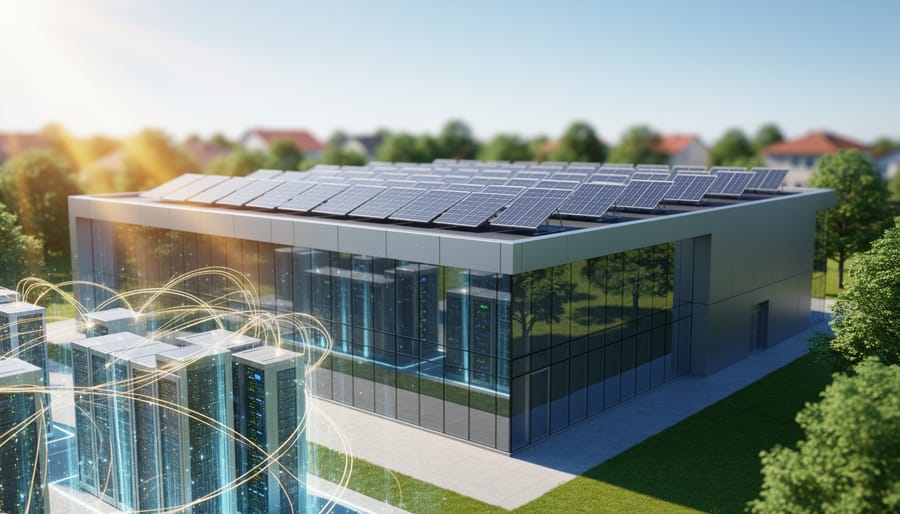
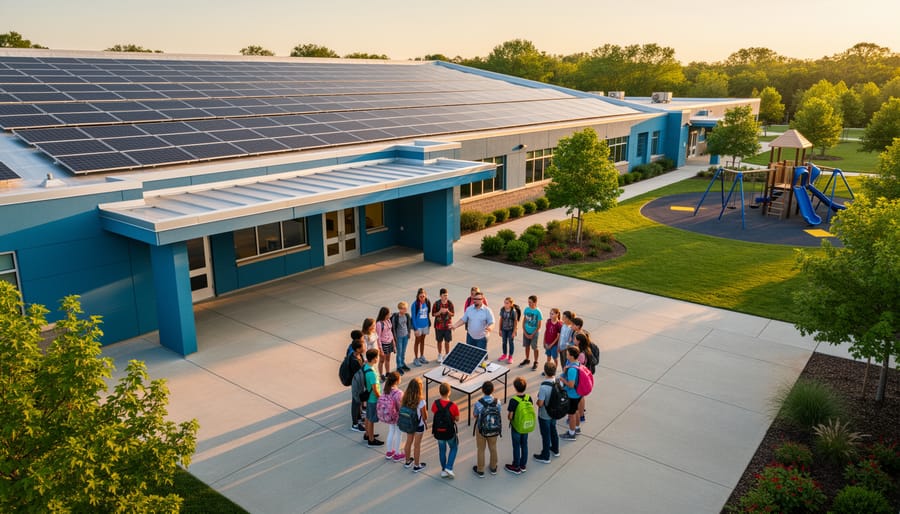
Install solar panels on your school’s roof to slash electricity costs by up to 75% while transforming your campus into a living laboratory where students witness renewable energy in action every single day. This single decision creates immediate financial savings that can redirect thousands of dollars toward classroom resources, teacher salaries, and student programs.
Transform science lessons by integrating real-time solar production data into mathematics, physics, and environmental studies curricula, allowing students to calculate energy output, track weather patterns, and understand the direct correlation between sunlight and power generation. Schools across the nation are proving that environments inspire climate action more powerfully than textbooks alone ever could.
Leverage Power Purchase Agreements (PPAs) or solar leases to install systems with zero upfront costs, making solar accessible even for districts with limited capital budgets. These financing models allow schools to start saving immediately while a third party handles installation, maintenance, and system performance.
Partner with local solar companies to create internship programs and career pathway opportunities, connecting students directly with growing clean energy industries while building workforce readiness. Schools in California, Massachusetts, and Arizona have already demonstrated how solar installations become catalysts for STEM engagement, reducing dropout rates and increasing student interest in engineering and environmental careers. The question isn’t whether your school should adopt solar energy—it’s how quickly you can harness this triple benefit of cost savings, educational enrichment, and environmental leadership.
Why Schools Are the Perfect Match for Solar Power
Schools possess unique characteristics that make them ideal for solar installations. Their expansive roof areas and open campus spaces provide ample room for solar panel arrays, often accommodating systems large enough to power entire facilities. Unlike residential properties with limited roof space, schools can generate substantial amounts of clean energy while maintaining their architectural integrity.
Perhaps the most compelling advantage lies in the perfect alignment between solar production and school operations. Solar panels generate peak electricity during daylight hours, precisely when classrooms buzz with activity, computers run learning programs, and HVAC systems maintain comfortable temperatures. This synchronization means schools consume the energy they produce in real-time, maximizing savings and reducing grid dependence. Summer vacation periods, when solar production remains high but building usage drops, allow schools to sell excess energy back to the grid, creating additional revenue streams.
Beyond the practical benefits, schools that adopt solar power become spaces that spark action within their communities. When students see solar panels on their school rooftops each day, renewable energy transforms from an abstract concept into a tangible reality. These installations serve as living laboratories where science lessons come alive, mathematics finds real-world application, and environmental stewardship becomes a visible commitment.
Schools also function as community anchors, influencing thousands of families through their students. A school’s decision to go solar sends a powerful message about sustainability priorities, often inspiring parents and local businesses to consider their own renewable energy options. This ripple effect amplifies the impact far beyond kilowatt-hours saved.
The financial benefits extend to the entire community as well. Money saved on electricity bills flows directly back into educational programs, teacher salaries, and student resources rather than disappearing into utility payments. This redirection of funds demonstrates how environmental responsibility and fiscal responsibility work hand in hand, creating a compelling case for solar adoption that resonates with diverse stakeholders.
Real Schools, Real Savings: Success Stories That Inspire
Across the country, schools of all sizes are transforming their energy footprint while creating powerful learning opportunities for students. These inspiring success stories demonstrate how solar energy isn’t just a smart financial decision—it’s an investment in education and community resilience.
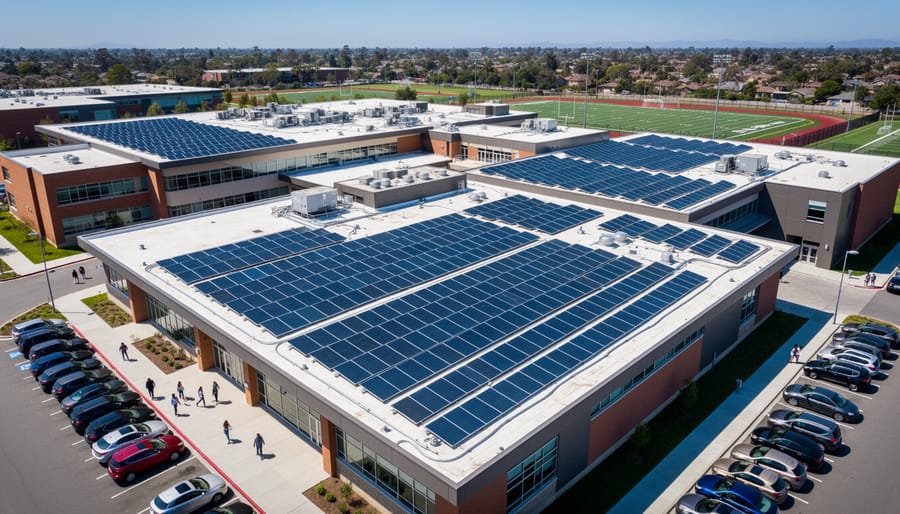
In California’s Kern High School District, one of the nation’s largest solar installations serves 18,000 students across 18 campuses. This ambitious project generates enough clean energy to power the entire district, resulting in savings of $7.7 million annually. These funds have been redirected toward classroom technology, teacher salaries, and after-school programs. Beyond the impressive financial returns, the district has woven renewable energy into its curriculum, with science classes using real-time data from the solar panels to explore energy production, weather patterns, and environmental science.
The district’s visible rooftop displays have sparked community-wide conversations about sustainability, inspiring local businesses to explore their own solar options.
Meanwhile, Luther Burbank Elementary School in San Francisco took a different approach, partnering with a nonprofit organization to install a modest 25-kilowatt system on their aging building. This small urban school serves a predominantly low-income community, and the project saves approximately $12,000 annually—enough to fund art supplies, field trips, and library books. Teachers have created engaging lesson plans around the solar array, with kindergarteners tracking sunny versus cloudy days and fifth graders calculating energy production. The project has become a source of pride for the neighborhood, demonstrating that solar energy is accessible regardless of budget constraints.
In North Carolina, the Chapel Hill-Carrboro City Schools system installed solar panels across multiple campuses while creating a comprehensive Solar Schools curriculum. Students monitor energy production through custom dashboards, conduct peer-led workshops on climate science, and even designed an award-winning community awareness campaign. The initiative has reduced electricity costs by 35 percent district-wide, while graduates report increased interest in STEM careers and environmental advocacy.
These diverse examples prove that solar energy works for schools of every size, location, and budget. The common thread? Forward-thinking administrators who recognized that solar panels deliver far more than kilowatt-hours—they power brighter futures for students and communities alike.
Turning Solar Panels into Classroom Learning Opportunities
Science and Math Come Alive with Real Data
When schools install solar panels, they gain more than clean energy—they unlock a living laboratory where science and math leap off the page. Real-time monitoring systems transform abstract concepts into tangible discoveries, allowing students to track exactly how much electricity their panels generate throughout the day.
Students can watch energy production rise with the morning sun, peak at noon, and taper off in the afternoon, creating natural opportunities to graph data and identify patterns. This hands-on observation helps them understand the relationship between the sun’s angle, seasonal changes, and power output. When clouds roll in, they witness immediate drops in generation, making weather’s impact on renewable energy crystal clear.
Mathematics comes alive as students calculate efficiency rates, convert watts to kilowatt-hours, and determine how many panels would power their homes. They apply real-world geometry by measuring panel angles and exploring how tilt affects performance. Physics principles like energy conversion, electrical circuits, and the photovoltaic effect become exciting topics when students see them working above their heads.
Many schools display production data on monitors in hallways, creating schoolwide engagement with energy topics. Students develop critical thinking skills by analyzing why production varies and proposing improvements. Some classes even compare their data with other schools in different climates, fostering collaborative learning about geography and environmental science.
This experiential learning approach has proven remarkably effective. Teachers report increased enthusiasm for STEM subjects, and students retain concepts longer when they can observe and measure real phenomena rather than simply memorizing formulas.
Beyond STEM: Environmental and Social Studies Integration
Solar education transforms classrooms into dynamic spaces where students explore the interconnected challenges facing our planet. When schools integrate solar systems into their curriculum, learning naturally extends beyond calculations and circuits into vital conversations about our environmental future and collective responsibility.
Through environmental stewardship lessons, students examine how renewable energy addresses climate change while studying carbon footprints, greenhouse gas emissions, and ecosystem impacts. Economics classes analyze the cost-benefit ratios of solar investments, exploring how falling panel prices make sustainable choices increasingly accessible. Meanwhile, civics courses use solar policy as a springboard for understanding government incentives, community organizing, and how citizens can influence energy decisions at local and national levels.
Solar installations open doors to rich, cross-curricular learning opportunities:
- Environmental science: tracking energy production data and calculating carbon offset equivalents
- Economics: comparing utility bills before and after solar installation to understand return on investment
- Civics: researching local renewable energy policies and presenting proposals to school boards
- Social studies: examining energy equity issues and how solar access varies across communities
- Geography: mapping solar potential across different regions and climate zones
These lessons empower students to become informed advocates for sustainable community planning. Schools in Portland and Denver have successfully engaged students in energy audits, helping identify efficiency improvements alongside solar adoption. This hands-on approach teaches that climate solutions require both technological innovation and social engagement, preparing tomorrow’s leaders to build resilient, sustainable communities.
Student-Led Solar Initiatives and Projects
Students are becoming powerful advocates for renewable energy through hands-on solar initiatives at schools nationwide. Solar clubs allow young learners to monitor energy production, track cost savings, and share their findings with the community. At Roosevelt High School in Seattle, a student-led energy team manages their rooftop solar array, recording daily output and presenting quarterly reports to school boards. These peer education programs transform students into renewable energy ambassadors who inspire classmates, families, and neighbors to embrace sustainable practices. Through creating action-oriented environments, schools empower students to take ownership of their learning while developing leadership skills. Student ambassadors organize campus sustainability fairs, lead facility tours explaining solar technology, and even partner with local elementary schools to teach younger children about clean energy. These initiatives demonstrate that when students actively participate in solar projects, they develop lifelong environmental stewardship and inspire meaningful change in their communities.
Making Solar Affordable: Funding Options for Schools
One of the biggest hurdles schools face when considering solar energy is the initial investment. The good news is that multiple financing pathways exist to make solar installations accessible, even for schools with tight budgets. Understanding these options empowers educational institutions to transition to clean energy without draining their operational funds.
Power Purchase Agreements (PPAs) have become increasingly popular among schools because they eliminate upfront costs entirely. Under this model, a third-party developer installs, owns, and maintains the solar system on school property. The school simply purchases the electricity generated at a predetermined rate, typically lower than utility prices. This approach provides immediate savings while transferring maintenance responsibilities to the provider.
Solar leases operate similarly to PPAs but with one key difference: schools pay a fixed monthly fee to use the equipment rather than paying for the electricity produced. This predictable expense makes budgeting straightforward and still results in lower energy costs over time.
| Funding Method | Upfront Cost | System Ownership | Best Suited For |
|---|---|---|---|
| Power Purchase Agreement | None | Third-party developer | Schools with limited capital |
| Solar Lease | None | Third-party developer | Schools wanting predictable costs |
| Direct Purchase | Full system cost | School district | Districts with available capital |
| Grant Funding | Partial to none | School district | All schools willing to apply |
For schools with available capital, direct purchase offers the greatest long-term financial benefits. Ownership means capturing all federal tax incentives, state rebates, and energy savings. While the initial investment is substantial, many districts see complete payback within 7-10 years, followed by decades of nearly free electricity.
Grant opportunities provide another exciting avenue. Federal programs, state clean energy initiatives, and private foundations regularly offer funding specifically for educational solar projects. The Department of Energy and various environmental organizations maintain active grant programs designed to support schools in their sustainability journeys.
Some innovative districts have even turned to community solar bonds or crowdfunding campaigns, engaging local residents as investors in their schools’ clean energy future. This approach builds community ownership while spreading financial participation across multiple stakeholders. Success stories abound of schools combining multiple funding sources—perhaps a grant covering 40 percent of costs with a PPA handling the remainder—creating custom solutions that fit their unique circumstances and financial capabilities.
Getting Started: A Practical Roadmap for Schools
Embarking on a solar journey may seem daunting, but breaking the process into manageable steps makes it achievable for any school. Here’s your practical roadmap to bringing clean energy and valuable learning opportunities to your campus.
Begin with a comprehensive energy audit to understand your school’s current electricity consumption and costs. Many utility companies offer free or low-cost assessments that identify your baseline energy needs. This data becomes essential for determining the appropriate solar system size and calculating potential savings. During this phase, form a green energy committee that includes administrators, teachers, facilities managers, and interested parents or community members who can champion the project.
Next, research available funding options and incentives. Federal tax credits, state rebates, and grants specifically designed for educational institutions can significantly reduce upfront costs. Organizations like the Solar Foundation and local clean energy coalitions often provide resources tailored for schools. Consider innovative financing models such as power purchase agreements or solar leases that require little to no money down, allowing your school to start saving immediately while a third party owns and maintains the system.
Once funding pathways are identified, request proposals from reputable solar installers with experience in educational settings. Look for companies that offer comprehensive warranties and have successful school projects in their portfolio. The best partners will work with you to design systems that meet both energy and educational goals, positioning panels where students can safely observe and learn from them.
Simultaneously, begin developing your educational program. Connect with teachers across disciplines to identify curriculum integration opportunities. Science classes can monitor real-time energy production data, math students can calculate savings and environmental impact, and social studies courses can explore renewable energy policy. Many solar companies provide free educational materials and dashboards that make learning interactive and engaging.
Finally, plan a celebratory launch event that involves the entire school community. Student presentations, panel installations ceremonies, and community open houses generate excitement and demonstrate your school’s commitment to sustainability. This celebration marks not an ending, but the beginning of your school’s bright solar future, inspiring students and community members alike to embrace clean energy solutions.
The Ripple Effect: How School Solar Inspires Entire Communities
When a school installs solar panels, the impact extends far beyond the campus boundaries. These visible installations become powerful conversation starters that spark interest throughout the entire community. Parents picking up their children notice the gleaming panels on rooftops, leading to dinner table discussions about renewable energy. Neighbors walking by ask questions. Local businesses begin considering their own sustainable options.
School solar projects serve as living demonstrations that make renewable energy tangible and accessible. Unlike abstract climate discussions, these installations provide concrete proof that clean energy works in real-world settings. Students bring home their excitement about learning from the school’s solar array, naturally becoming ambassadors for sustainable practices. This grassroots education ripples outward, reaching families who might never have considered solar power otherwise.
Our solar installation transformed how our community views renewable energy—suddenly it wasn’t something distant or theoretical, but right here, powering the place where our children learn every day.
The influence extends to other institutions as well. When one school successfully implements solar energy, neighboring schools take notice. Libraries, community centers, and municipal buildings often follow suit, creating a network effect that accelerates regional adoption. This collective movement toward sustainability demonstrates how educational institutions can lead by example, inspiring community-wide climate action through practical demonstration rather than mere advocacy.
The economic benefits also create compelling arguments. As parents and community members witness schools reducing energy costs while educating students, the value proposition becomes clear. Success stories spread through school board meetings, parent-teacher associations, and local media, building momentum for broader renewable energy adoption. Schools essentially become the catalyst for community-wide transformation toward sustainable practices.
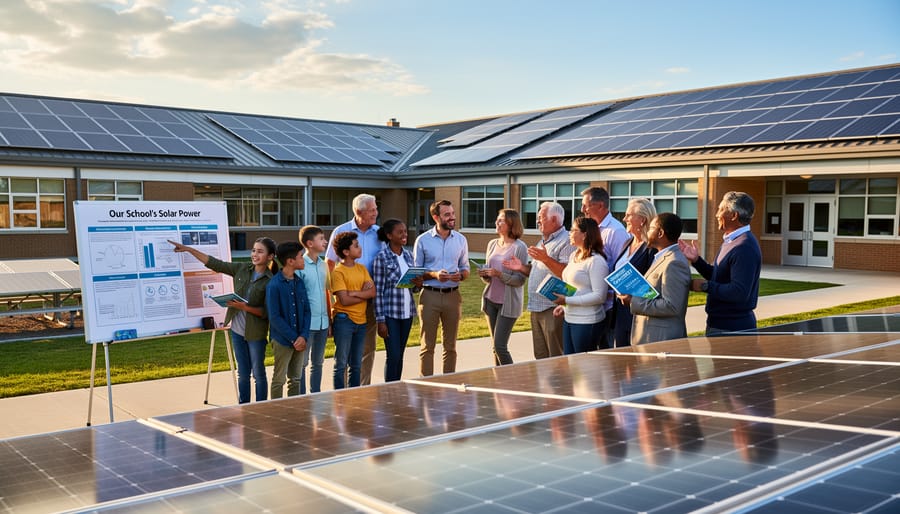
Investing in solar energy for schools is more than a financial decision—it’s a commitment to shaping a sustainable future. Schools that embrace solar power immediately benefit from reduced energy costs, freeing up valuable resources for educational programs, technology, and teacher support. Beyond the balance sheet, these installations transform campuses into living laboratories where students witness renewable energy in action every day.
Each solar panel becomes a teaching tool, sparking curiosity about climate science, energy systems, and environmental stewardship. Students who learn alongside working solar installations don’t just understand sustainability theoretically—they become passionate advocates who carry these values into their homes and future careers. This ripple effect creates communities of informed citizens ready to tackle tomorrow’s environmental challenges.
The path to solar adoption has never been clearer. With abundant financing options, supportive federal and state incentives, and proven success stories across the country, schools of all sizes can participate in the renewable energy movement. Whether your institution starts with a single array or a comprehensive campus-wide system, you’re joining thousands of forward-thinking schools already leading the clean energy transition.
Now is the time to explore solar options for your school. Research local installers, connect with schools that have made the switch, and discover how your institution can reduce costs while empowering the next generation of environmental champions.